
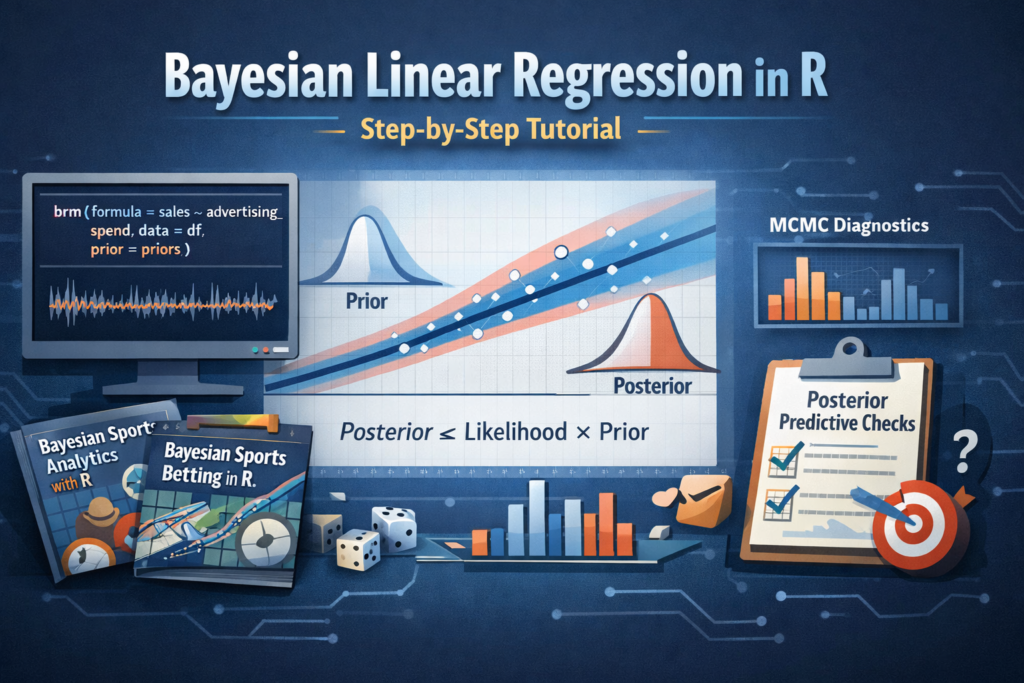
Bayesian linear regression in R tutorial showing priors, posterior distributions, regression model, and MCMC diagnostics

Bayesian Linear Regression in R: A Step-by-Step Tutorial

Bayesian linear regression is one of the best ways to learn Bayesian modeling in R because it combines familiar regression ideas with a more realistic treatment of uncertainty. Instead of estimating a single fixed coefficient for each parameter, Bayesian methods estimate full probability distributions. That means we can talk about uncertainty, prior beliefs, posterior updates, […]

Bayesian Linear Regression in R: A Step-by-Step Tutorial Read More »

Formula 1 data analysis in R using the f1dataR package, showing lap time charts, pit stop strategy graphs, and driver performance visualizations on a laptop.

Formula 1 Analysis in R with f1dataR: Lap Times, Pit Stops, and Driver Performance

Formula 1 is one of the most compelling areas for data analysis in R because it combines structured results, lap-by-lap timing, pit strategy, and driver performance into one of the richest datasets in sport. For anyone building authority in technical R content, this is an excellent niche: it is specific enough to stand out, but

Formula 1 Analysis in R with f1dataR: Lap Times, Pit Stops, and Driver Performance Read More »

Esports analytics in R showing Dota 2 and CS:GO themes with data visualizations, R programming code, charts, and a machine learning dashboard predicting Dota 2 match outcomes.

eSports Analytics in R: Predicting Dota 2 Matches

eSports analytics is still an underexplored area in the R ecosystem, which makes it a great niche for practical, original work. While football, basketball, and betting models already have strong communities, competitive games such as Dota 2 and Counter-Strike offer rich event data, fast feedback loops, and interesting prediction problems. In this post, I will

eSports Analytics in R: Predicting Dota 2 Matches Read More »

Illustration of hierarchical Bayesian models in R using brms, showing partial pooling, shrinkage estimation, posterior distributions, and predictive checks on sports data.

How to Fit Hierarchical Bayesian Models in R with brms: Partial Pooling Explained

Hierarchical Bayesian modeling (also called multilevel modeling) is one of the most reliable ways to build predictive and inferential models when your data has natural grouping—teams, players, seasons, leagues, referees, venues, or even game states. In sports analytics, that grouping is unavoidable. In R, hierarchical Bayesian models are commonly implemented via brms (Stan), rstanarm, or

How to Fit Hierarchical Bayesian Models in R with brms: Partial Pooling Explained Read More »

Football Betting Model in R (Step-by-Step Guide 2026)

Related (on this site): Install & Use worldfootballR worldfootballR Guide Sports Analytics with R NFL Analytics with R Tennis Analytics with R Boxing Analytics with R Bayesian Sports Analytics (Book/Product) Contents Setup Get match data Feature engineering Model 1: Poisson goals (baseline) Model 2: Dixon–Coles adjustment (improves low scores) From scorelines to 1X2 probabilities Odds,

Football Betting Model in R (Step-by-Step Guide 2026) Read More »

Hero image for a blog post on quantitative horse racing with R, showing three racehorses sprinting under stadium lights while data visualizations, probability formulas, network graphs, and financial charts overlay the scene. The headline reads “Quantitative Horse Racing with R: Calibration, Backtesting, and Deployment,” with icons representing DuckDB, Parquet, modeling, backtesting, and API deployment integrated into a high-tech analytics theme.

Quantitative Horse Racing with R: Calibration, Backtesting, and Deployment

R DuckDB Parquet Calibration Ranking Bayesian Odds TS Backtesting Racing analytics as an inference-and-decision system Thoroughbred flat racing is not a binary classification problem. It is a multi-competitor outcome process with hierarchy (horse / trainer / jockey / track), time dependence (form cycles, market moves), and decision layers (how you act on probabilities). This macro

Quantitative Horse Racing with R: Calibration, Backtesting, and Deployment Read More »

Digital illustration of Machine Learning for Sports Analytics in R featuring athletes, data visualizations, Random Forest and XGBoost diagrams, performance charts, and R code on a laptop inside a stadium background.

Machine Learning for Sports Analytics in R: A Complete Professional Guide

Table of Contents 1. Introduction to Machine Learning in Sports Analytics Machine Learning has transformed modern sports analytics. What was once limited to box scores and descriptive statistics has evolved into predictive modeling, simulation systems, optimization engines, and automated scouting pipelines. Today, teams, analysts, researchers, and performance departments rely on machine learning to gain measurable

Machine Learning for Sports Analytics in R: A Complete Professional Guide Read More »

Illustration of sports analytics in R showing Elo ratings, Monte Carlo simulations, win probability charts, and R code on screens inside a stadium, representing sports prediction modeling.

How to Predict Sports in R: Elo, Monte Carlo, and Real Simulations

R • Sports Analytics • Ratings • Monte Carlo • Forecasting Sports are noisy. Teams change. Injuries happen. Upsets happen. But uncertainty is not the enemy—it’s the input. In this hands-on guide you’ll build a practical sports prediction workflow in R using tidyverse, PlayerRatings, and NFLSimulatoR, then connect ratings to Monte Carlo simulations and forecasting

How to Predict Sports in R: Elo, Monte Carlo, and Real Simulations Read More »

Illustration of a Bayesian sports betting system in R showing probability distributions, expected value, Kelly strategy charts, betting odds, and bankroll management visuals.

Designing Sports Betting Systems in R: Bayesian Probabilities, Expected Value, and Kelly Logic

A good sports betting system is not a “pick-winners” machine. It’s an uncertainty engine: it turns data into probabilities, probabilities into expected value, and expected value into position sizes that survive variance. If you can do those three steps consistently, you can build a robust process— even if individual bets lose often. This post is

Designing Sports Betting Systems in R: Bayesian Probabilities, Expected Value, and Kelly Logic Read More »

Fight data science in R dashboard showing boxing performance statistics, modeling metrics, and round-by-round analysis

Fight Data Science in R: Proven Boxing Metrics & Models

Boxing analysis is no longer just about punch totals or “who looked busier.” Modern fight analysis is data science: repeatable pipelines, validated data, explainable models, and performance indicators that translate into strategy. This post shows how to build a professional fight data science workflow in R—from raw data to metrics, modeling, and tactical insights—using code

Fight Data Science in R: Proven Boxing Metrics & Models Read More »