
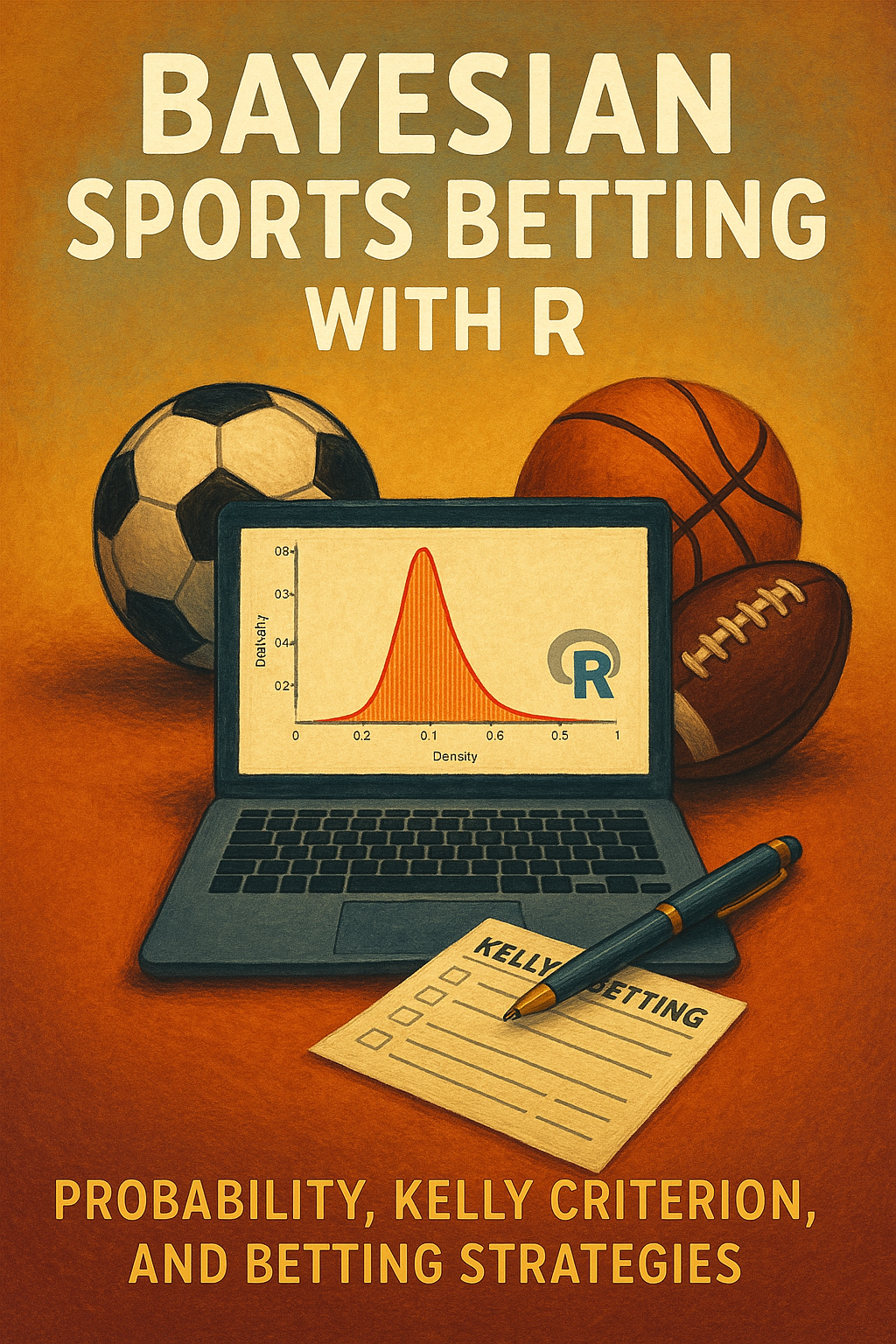
Take your sports betting analysis to the next level with this in-depth professional guide. Combining cutting-edge statistics with practical applications, this book introduces a rigorous framework for modeling sports outcomes, calculating probabilities, and managing risk—powered by the R programming language.
Unlike quick guides, this professional edition spans over a dozen chapters, complete with real-world examples, detailed theory, R code snippets, and case studies across major sports such as soccer, basketball, American football, tennis, and baseball.
Key features include:
-
Foundations of Probability & Bayesian Inference – Learn how to update beliefs with Bayes’ theorem and apply modern statistical thinking to dynamic sports markets.
-
Data Acquisition & Processing – Import, clean, and visualize sports betting data with tidyverse, ggplot2, and other essential R packages.
-
Frequentist & Bayesian Models – Explore logistic and Poisson regression, hierarchical models, and advanced Bayesian techniques using rstanarm and brms.
-
The Kelly Criterion – Understand and apply the mathematics of optimal bet sizing to maximize long-term bankroll growth, including fractional and risk-adjusted variations.
-
Sport-Specific Strategies – Tailored modeling approaches for soccer (Poisson/Dixon-Coles), basketball, football, tennis, and baseball.
-
Bankroll Management & Risk Control – Learn how to minimize risk of ruin, analyze volatility, and apply disciplined staking strategies.
-
Responsible Gaming & Legal Context – Insights into ethics, problem gambling awareness, and the importance of compliance with local laws.
Whether you are a data scientist, sports analyst, or serious bettor, this book bridges the gap between theory and application. You’ll not only master probabilistic modeling and decision-making but also gain a transferable skill set in statistics, risk management, and R programming.
Pages: 23



Daniel R. – Data Analyst –
I’ve read quite a few sports betting books over the years, and most of them tend to recycle the same ideas or oversimplify the subject. This one clearly takes a different approach.
What stood out to me is that the book doesn’t try to sell a “winning system.” Instead, it focuses on understanding probability, uncertainty, and risk, and shows how to approach sports betting from a more analytical and disciplined perspective using R. The explanations around Bayesian thinking and belief updating helped me rethink how I evaluate teams and betting markets over time.
The chapter on the Kelly Criterion was particularly useful. I had seen Kelly mentioned many times before, but here it’s derived properly and discussed in a realistic way, including why full Kelly can be too aggressive when probabilities are uncertain. The examples and simulations made the trade-offs very clear.
This is not a beginner-level book. Some familiarity with R and basic statistics is definitely needed, and readers looking for quick betting tips will likely be disappointed. However, for anyone with a data-driven mindset who wants to understand the why behind betting decisions, this book delivers.
I also appreciated the attention given to bankroll management and responsible betting, which is often ignored in similar books. Overall, it’s a solid and thoughtful resource for serious readers who want a more professional approach to sports betting analytics.
Zola Dixon –
just finished reading and i have to say i am very impressed with the level of detail u put in. u covered all the bases and left no stone unturned which i really appreciate as someone who likes to know the “why” behind things. thanks for the hard work and for sharing your passion with all of us. u are a legend in my book and i will be back for sure!